





When Hidden Symmetries Break a New Cosmic Clue

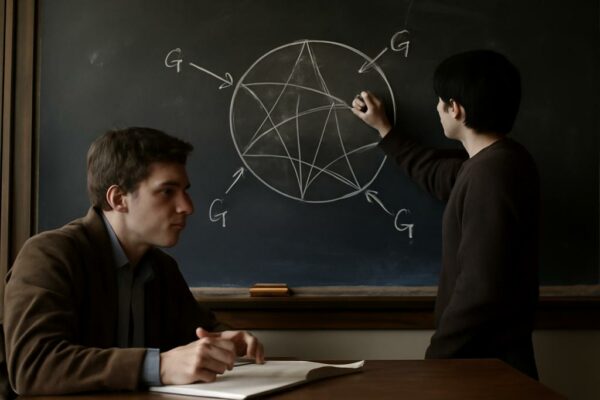
Cosmic space is not just empty—it’s a theater where symmetry plays the lead role. The rules that describe how objects and light move in spacetime are deeply tied to hidden, almost musical patterns. When those patterns break or reorganize, new behavior emerges in ways that physicists can track and mathematicians can classify. The work we’re…

Read More

AI’s New Eyes: Seeing the Unlikely

Imagine a world where predicting rare, impactful events isn’t a matter of sheer luck, but of carefully crafted mathematical insight. That’s the promise of a groundbreaking new study from Utah State University, which introduces two novel heuristics for understanding rare events in complex systems. These aren’t just theoretical tweaks; they could dramatically alter how we…

Read More

Dynamical Networking by Gaussian Fields Unveils Hidden Ties

In modern science, the difference between a static scaffold and a living mesh is everything. Cells hum with cross‑linked polymers and motors that crawl along filaments; synthetic materials hinge on bonds that form and break as conditions change. A new theoretical framework from Stellenbosch University tackles this complexity head‑on by treating networking as a dynamic…

Read More

Can We Trick Our Brains into Saving the Planet?

The Psychological Distance Problem We face a curious paradox. We know climate change is a looming catastrophe, yet many of us struggle to act. The reason, according to new research from the University of Toronto, might lie in something called “psychological distance.” This isn’t about physical distance, but rather the way our brains process information…

Read More

When Numbers Refuse to Align How Weighted Approximations Rewrite Math’s Rules

The Puzzle of Perfect Approximation At the heart of mathematics lies a deceptively simple question: how well can we approximate real numbers by rational ones? This question, which echoes through centuries of mathematical thought, is the essence of Diophantine approximation. It’s about finding integer solutions that come tantalizingly close to hitting a target defined by…

Read More

AI Predicts the Best Quantum Computer for Your Problem

The Quantum Hardware Conundrum Imagine a future where quantum computers are as commonplace as smartphones, readily solving problems currently beyond the reach of classical computing. But a major hurdle remains: selecting the right quantum computer for a given task. Quantum hardware isn’t monolithic; different technologies—like superconducting qubits and trapped ions—each have unique strengths and weaknesses….

Read More

Can external trial controls ever be trusted again?

Highlights A new statistical approach makes externally controlled single-arm trials more trustworthy by marrying two ideas: balancing covariates to mimic a randomized comparison, and modeling outcomes to guard against misspecification. The result is a doubly robust method that performs well when either the covariate balance model or the outcome model is correct, improving precision and…

Read More

A Multimodal Minecraft Agent Expands Open Learning

In the grand quest for artificial intelligence that can roam beyond its training data, researchers chase a delicate, almost human trait: curiosity that doesn’t burn out. Open-ended learning is the dream that an AI could keep picking up new tasks, remixing old skills, and solving problems it has never seen before. It’s not just about…

Read More

Tailor-made error shields could fix quantum memory at scale

Quantum computers promise to solve problems classical machines can’t crack, but their memory layer—the quantum random access memory, QRAM—has been the stubborn bottleneck. QRAMs are meant to let a quantum processor fetch data from a database in a superposition, enabling powerful operations like searching an unordered database or assembling a desired quantum state directly from…

Read More