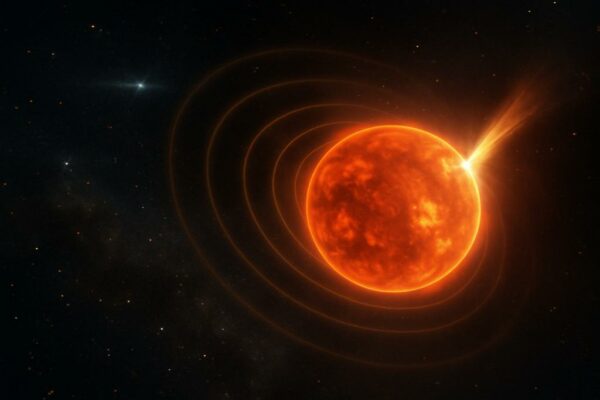






Dancing Dark Energy Across Spacetime With Curved Gravity

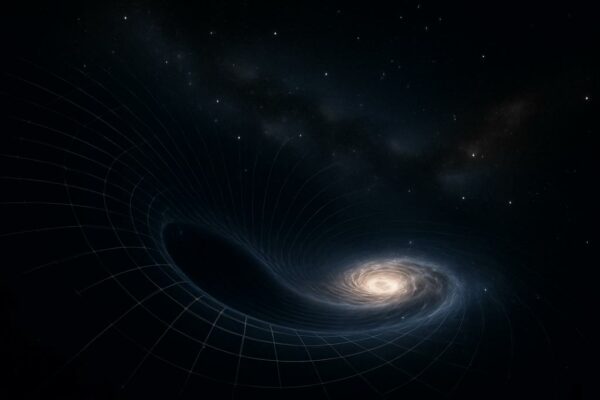
The universe isn’t just accelerating; it’s hinting at a choreography we’re only beginning to understand. For decades, cosmologists have described dark energy as a mysterious pressure that pushes the cosmos apart, a force that could be constant like a cosmological background glow or subtly dynamic like a moving orchestra. Recent observations from projects such as…

Read More

When primes whisper, numbers reveal their secrets

Numbers don’t just sit there on a page; they strut with personality, stubbornness, and the occasional flourish of mystery. In the quiet world of number theory, researchers chase patterns that feel like fingerprints of the universe, tiny clues about why certain arithmetic rules bend the way they do. A new study from the Indian Institute…

Read More

MoS2 carbon doping myth exposed by defect map

The family of two‑dimensional materials known as transition metal dichalcogenides has long teased potential—from ultra-thin transistors to solar cells and beyond. MoS2, in particular, rose to prominence because it combines the elegance of a atomically thin sheet with a usable bandgap and surprising mechanical strength. But the dream of turning MoS2 into a perfectly tuned…

Read More

Could a clever bridge cut quantum processing time?

Quantum computing isn’t only about bigger qubits. It is about the rhythm of tiny quantum states and how we guide them to do useful work. A new study stitches together two seemingly different ideas, Quantum Signal Processing and the Adiabatic-Impulse Model, to show a path to faster, more robust single qubit operations. Researchers from the…

Read More

A Family Tree for Labels Awakens Medical AI

In the glow of the operating room, a hyperspectral camera peers at tissue in wavelengths our eyes cannot see. It paints a spectral map that can separate tumor from healthy brain, or distinguish a blood vessel from surrounding tissue with a precision that feels almost cinematic. But turning that map into a reliable guide requires…

Read More

Could Topology Close Sim2Real Gaps in 3D Data?

Three-dimensional point clouds are the modern handwriting of the physical world. They’re how robots “see” a coffee mug, how autonomous cars understand a curb, how AR systems map a room for your next meeting. Yet there’s a stubborn snag: what the machine learns from pristine synthetic shapes often stops translating when it faces the messy,…

Read More