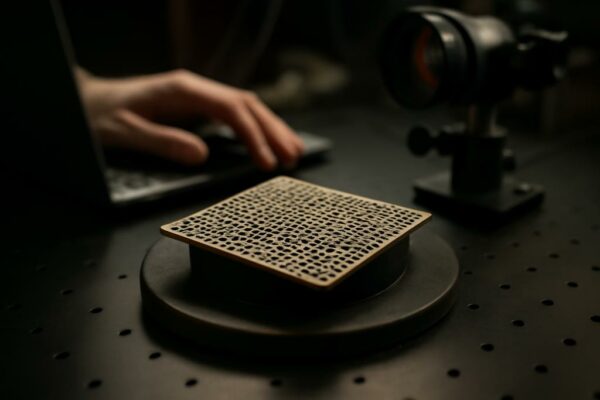






A Learning Agent Tames Quantum Sensing Noise with Spins

Quantum sensing promises to measure tides of reality that are invisible to ordinary devices: magnetic fields that drift like ghost winds, tiny rotations, minute shifts in energy landscapes. Yet the very thing that makes quantum sensors so powerful — their fragility — is also what makes them hard to deploy outside pristine laboratories. Decoherence, tiny…


Read More

When AI Chooses Our Priors, What Is Uncertainty?

Bayesian statistics often feels like a delicate negotiation between what we already know and what the data will reveal. The priors are the first step in that conversation, the beliefs you bring to a model before you even glimpse the numbers. When those priors are well-chosen, the data can sing in tune with them; when…

Read More

When Math Mirrors Itself: A Banach Space’s Hidden Symmetry

Imagine a perfectly balanced scale, where each side represents a different aspect of a mathematical structure. This analogy, while imperfect, helps capture the essence of Sudeshna Basu’s groundbreaking work on Banach spaces, a field of mathematics dealing with abstract vector spaces. Basu’s research, conducted while visiting the National Institute of Science Education and Research Bhubaneshwar,…

Read More

Can AI Read Doctor’s Notes to Detect Disease?

The notes inside electronic health records resemble a bustling city at noon: patient stories, test results, medication lists, and the quiet whispers of clinicians’ judgments. They’re essential for understanding a patient’s health, but they’re also messy, unstructured, and enormous in volume. That combination has kept researchers from turning those notes into scalable, real-time health signals—until…

Read More

Can a frozen transformer still learn new moves?

In the world of artificial intelligence, bigger has often meant better. Large language models keep swelling, soaking up more data, parameters, and compute until they feel almost like a force of nature. Yet there’s a growing ache behind the thrill: how do we keep quality from exploding alongside cost? A team of researchers led by…

Read More

Do Tiny Stars Brew Carbon Rich Disks for Planets?

What the study is about and why it matters In the birthplace of planets, the chemistry inside the innermost few astronomical units of a protoplanetary disk sets the ingredients for rocky worlds, oceans, and atmospheres. The inner disk is a furnace where simple molecules get transformed into more complex carbon bearing species, and where the…

Read More

AI predicts titanium nitride’s secrets, revolutionizing materials science

Researchers at the Indian Institute of Technology Madras have developed a groundbreaking artificial intelligence model that can accurately predict the properties and stability of titanium nitride (Ti-N) compounds. This seemingly niche achievement ripples far beyond the lab, potentially impacting everything from aerospace engineering to the design of medical implants. The Titanium Nitride Enigma Titanium nitride…

Read More

When Robots Feel Their Way They Move Like Us

Why Feeling Matters More Than Seeing for Robots Robots opening doors, pulling drawers, or twisting knobs might sound like a mundane chore, but it’s a surprisingly complex dance of touch, prediction, and adaptation. At the heart of this challenge is the robot’s ability to understand and manipulate objects that aren’t rigid or fixed — things…

Read More

The Hunt for the Perfect Sound Metric Might Fail

In music, the journey from intention to sound is a dance of knobs and ears. An artist tweaks filters, envelopes, and waveforms, chasing a target that only exists in memory—the moment when a synth sounds exactly like what the brain hears. Today’s researchers are teaching computers to join that dance, not by replacing the musician…

Read More