




Unlocking the Monster: A New Structure for the Universe’s Biggest Group

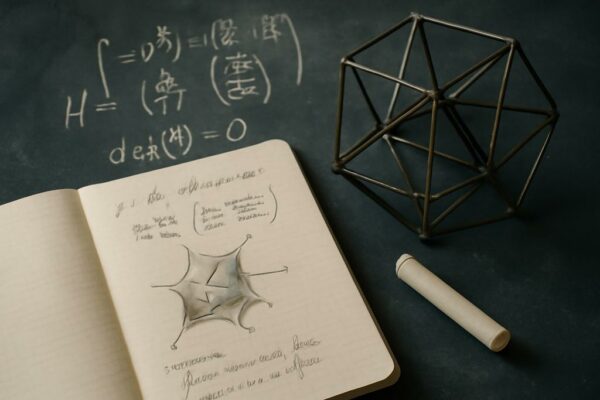
The Monster group. It’s the name mathematicians give to the largest sporadic simple group, a truly colossal structure with over 800 billion billion billion members. It sounds like science fiction, but it’s a real mathematical object with profound implications for our understanding of symmetry, algebra, and the deep connections between seemingly disparate areas of mathematics….

Read More

When Tiny Particles Mimic a Universe’s End

When Tiny Particles Mimic a Universe’s End Imagine a universe collapsing in on itself, a miniature Big Crunch played out not among galaxies but among particles smaller than a speck of dust. That’s essentially what researchers at the Institute for Theoretical Physics at TU Wien have witnessed, not in the cosmos, but in a meticulously…

Read More

Five Planes Unveil Geometry’s Hidden Grammar.

Geometry sits at a peculiar crossroads. It houses the smooth continuity of lines and surfaces while also harboring a stubborn discrete side: how many ways can pieces intersect, split space, and create new regions? Stefan Forcey, at The University of Akron, leads us into that boundary in Counting Plane Arrangements via Oriented Matroids. The paper…

Read More

The Golden Ratio’s Secret Power Over Network Growth

The Unexpected Power of Self-Reinforcement Imagine a social network where popularity isn’t just about connections; it’s about the *history* of those connections. That’s the essence of a new mathematical model, developed by Yogesh Dahiya of the Indian Institute of Science Education and Research (IISER) Mohali and Frank den Hollander of Leiden University, that explores “self-reinforced…

Read More

Whispers from Africa: AI Learns to Listen in 2,300 Languages

The Untapped Potential of African Languages Africa, a continent pulsating with a vibrant tapestry of over 2,300 languages, has largely remained unheard in the digital world. Speech technology—the ability of computers to understand and generate human speech—has primarily focused on a handful of dominant languages, leaving a vast linguistic landscape unexplored. This digital silence excludes…

Read More

When Fluids Decide to Split and Diffuse

In a laboratory in Beijing and another in Shenzhen, a team of mathematicians and physicists set out to choreograph a very stubborn waltz: how a compressible, heat-bearing fluid with two immiscible phases can phase-separate, form diffusion interfaces, and evolve over time without spiraling into chaos. Their instrument of choice wasn’t a telescope or a centrifuge…

Read More

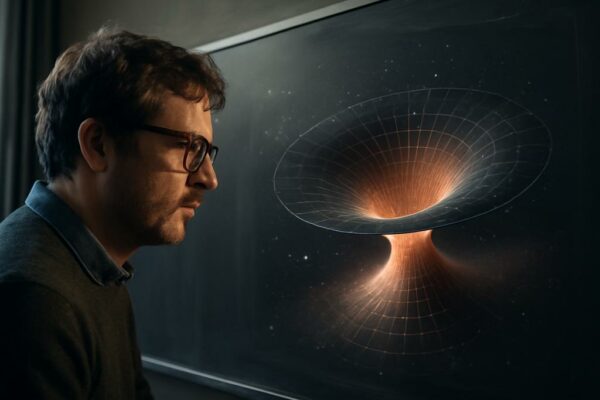
Are Wormhole Throats Really Stable in Our Universe?

Wormholes have always hovered between science and myth—the imagined tunnels through spacetime that could, in principle, connect distant regions of the cosmos. A new study from the University of Texas at Dallas, led by Travis Rippentrop, Avijit Bera, and Mustapha Ishak, digs into a pressing question behind that science-fiction gloss: can these thin-walled bridges stay…

Read More

Anomaly Maps Guide AI to Find Prostate Cancer

In MRI suites around the world, radiologists parse intricate textures and shapes, hunting for the telltale signs of clinically significant prostate cancer. It’s a careful craft, a blend of pattern recognition and medical intuition, and it can be slow—especially when clinicians must comb through thousands of slices to segment the exact tumor boundaries. A new…

Read More