




An optical neural network that trains at light speed

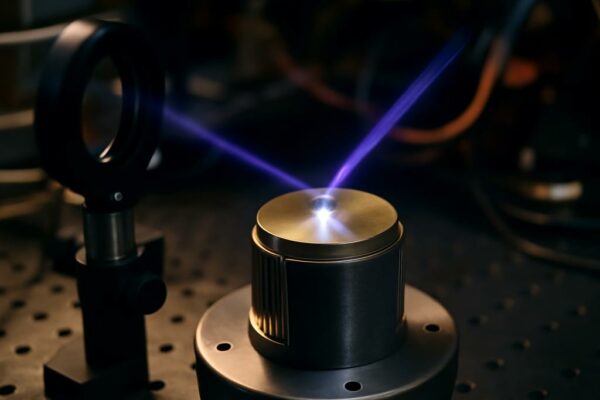
Light has always carried information, but only recently have we tried to choreograph it as a learning partner. Traditional AI training relies on electricity and silicon, grinding through colossal amounts of data on power-hungry hardware. It’s a race against heat, latency, and the planet’s tolerance for energy use as machine learning models grow hungrier and…

Read More

AI’s Tiny Triumph: Guiding Radioactive Needles with Microscopic Precision

Imagine a microscopic dance, a precise ballet of radiation, targeting a tumor with the grace of a surgeon’s scalpel. This is the essence of brachytherapy, a cancer treatment where radioactive sources are carefully placed near tumors. While incredibly effective, planning this procedure is incredibly challenging and time-consuming –– until now. Researchers at Leiden University Medical…

Read More

Two-Parameter Quantum Worlds Unfold at Roots of Unity

The abstract playground where math and physics meet has a habit of unfolding in unexpected directions. Quantum groups, once whispers in a physics lab, have grown into a rich landscape of noncommutative symmetry that helps us model everything from particle interactions to knot invariants. In recent years, mathematicians have been exploring two-parameter families of these…

Read More

Could AI Learn to Pentest Web Apps on Its Own?

Intro Cybersecurity often feels like a high-stakes game of chess played on a sprawling, ever-changing board. Defenders patch holes, monitor traffic, and chase down elusive weaknesses, while attackers scout for the tiniest misstep to exploit. For decades, penetration testing has been a human-led craft: security experts map a network, probe forms, test credentials, and chase…

Read More

When Numbers Refuse to Align How Weighted Approximations Rewrite Math’s Rules

The Puzzle of Perfect Approximation At the heart of mathematics lies a deceptively simple question: how well can we approximate real numbers by rational ones? This question, which echoes through centuries of mathematical thought, is the essence of Diophantine approximation. It’s about finding integer solutions that come tantalizingly close to hitting a target defined by…

Read More

SKA Could Decode the Hidden Gas in Galaxy Cavities

Deep in the cosmic seas where galaxy clusters form and reign, there are giant bubbles inflated by jets from supermassive black holes. These cavities push aside hot gas, creating X-ray faint pockets that glow faintly in radio waves. The Sunyaev-Zel’dovich (SZ) effect—the way the cosmic microwave background is distorted as it passes through hot electrons—offers…

Read More

AI predicts airflow, ignoring most of the data

Researchers at ONERA and the Institute of Mathematics of Toulouse have developed a new AI-powered method for simulating fluid flows. Forget about meticulously feeding your algorithm every single data point. This method, surprisingly, can accurately predict airflow patterns even when it’s missing the vast majority of data points. It’s like having a hyper-intuitive weather forecaster…

Read More

When Math Mirrors Reality: Unbounded Solutions to a Schrödinger Equation

The seemingly abstract world of mathematics sometimes throws a curveball, unexpectedly mirroring the complexities of the physical universe. A recent paper from the University of Bari Aldo Moro sheds light on this intriguing interplay by exploring the existence of solutions to a modified Schrödinger equation on unbounded domains. The researchers, A.M. Candela, G. Palmieri, and…

Read More

Can ‘Self-Aware’ AI Spot the Flaws We Miss?

Imagine a world where robots don’t just assemble your gadgets, but also obsessively check their own work, catching tiny defects before they become big problems. That’s the promise of a new AI system called Self-Navigated Residual Mamba (SNARM), developed by researchers at Jiangxi Normal University and several other institutions. The Problem: Spotting Tiny Flaws in…

Read More