





Planar Graphs: A Hidden Order in Networks

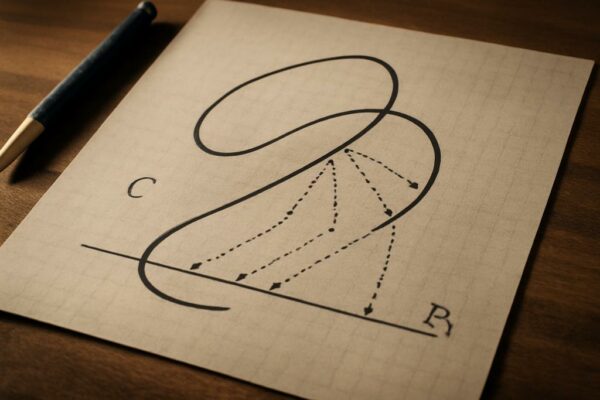
Unveiling the Secrets of Planar Triangulations Imagine a perfectly tiled surface, each tile a tiny triangle. Now, picture intricate pathways weaving through these triangles, forming closed loops of various lengths. These pathways represent cycles in a planar triangulation, a fundamental structure in graph theory with far-reaching implications in fields like coding theory and network analysis….

Read More

When Your Iris Becomes a Locked Vault

Biometric security feels like magic at first glance: a fingerprint that unlocks a phone, an iris scan that logs you into a car, a face that replaces a password. But the real story is messier and more human. Behind every smooth unlock is a constant balancing act between convenience, privacy, and the risk that data…

Read More

When AI Chooses Our Priors, What Is Uncertainty?

Bayesian statistics often feels like a delicate negotiation between what we already know and what the data will reveal. The priors are the first step in that conversation, the beliefs you bring to a model before you even glimpse the numbers. When those priors are well-chosen, the data can sing in tune with them; when…

Read More

A digital brain that streams data from detectors

In the noisy, high-stakes world of nuclear physics, detectors are more than sensors. They’re tremulous listeners that emit streams of tiny signals when atoms rearrange, ions crash, or photons whisper from a gamma-ray shower. The critical trick is not just catching a single flash accurately, but handling thousands of signals in parallel, every nanosecond counting….

Read More

Simplicity Signals a New Proof of Occam’s Razor

If you’ve ever felt the pull of a simpler explanation amid a storm of complexity, you’re not alone. A new preprint argues that simplicity isn’t just a stubborn heuristic but a mathematically grounded guide to truth. The author, Gabriel Leuenberger, lays out a modernized proof of Occam’s razor that scales across all intelligible scientific models,…

Read More

AI Fails to Grasp Populism’s Nuances: Trump’s Rhetoric Reveals AI’s Limits

Can artificial intelligence truly understand the subtleties of human politics? A new study from the University of Copenhagen, led by Ilias Chalkidis, Stephanie Brandl, and Paris Aslanidis, throws cold water on that idea. Their research delves into the surprisingly complex task of using AI to identify populism in political speech, revealing unexpected limitations in even…

Read More

Could OTFS calm mmWave chaos across cells today?

The paper behind this piece isn’t about a single dazzling gadget or a flashy experiment. It’s about how the invisible plumbing of future wireless networks might work more gracefully when there are many cooks in the kitchen. In mmWave downlinks—those ultra-fast wireless links that promise mind-boggling data rates but hate getting blocked by a coffee…

Read More